 Philosophy Under the Olives |
 Supported by Municipality of Ascea, Cilento, Italy |
 |
 |
||
| The Parmenideum | Encounters | Accommodation | Arrival | Location | Enquire | ||
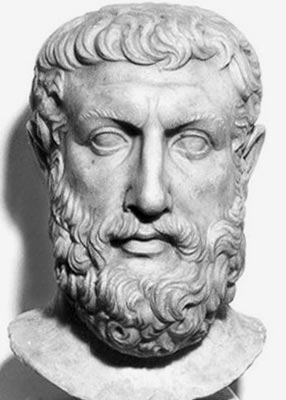
Parmenides
On Nature
| Philosophy Jokes |
| Formal seminars and conferences In addition to the general day to day discourse there are, from time to time, formal seminars given by professional philosophers... However, good wine and excellent dining is ever integral... Read More |
Molyneux's Problem
"Suppose a Man born blind, and now adult, and taught by his touch to distinguish between a Cube, and a Sphere of the same metal, and nighly of the same bigness, so as to tell, when he felt one and t'other; which is the Cube, which the Sphere. Suppose then the Cube and Sphere placed on a Table, and the Blind Man to be made to see. Qaere, Whether by his sight, before he touch'd them, he could now distinguish, and tell, which is the Globe, which the Cube."
Translation: If someone blind from birth who has learned to distinguish between and cube and a sphere only by touch has their sight restored, would they then be able to identify which is which by sight alone?
This problem was presented to British
philosopher John Locke in
1688 by Irish philosopher William Molyneux and published as the above
in Locke's An Essay Concerning Humane Understanding in 1694.
Since that time till the present day philosophers, scientists, mathematicians,
neuroscientists and thinkers in general have all tried to answer the problem.
Below is one more attempt - long winded, contorted, obscure and rambling
no doubt (as any respectable response to such an eminent problem should
be) - to which you are invited to add your own or comment, respectfully
or otherwise. Please send your solution or comment to us using the form
on the contact page
A response to the Molyneux Problem
(Note: the previously blind man is not permitted to touch the objects once his sight is restored
until he makes a declaration of which is which, based purely on a judgment through sight).
The assumption, by those who deny an affirmatice answer to the problem, usually base such a judgment on the apparent impossibility of sharing and correlating information - regarding spatial and sensorial properties of objects - between the visual and tactile modes of perception.
Implicit in this assumption is that the attributes of perception in these modes contain information only with regard to the spatial properties of the object. However, the spatial properties of the objects are not the only properties that gave rise to perceptual attributes. There is another perceptual attribute (percept) that must be considered, which is the time component of the experiences in both the tactile and visual modes. We cannot divorce space from time with regard to perceptual experience since experience unfolds in time and any perception - say of hard corners, straight edges and flat surfaces on the cube - will have the more primitive attribute of quantity. The person will have a sense of both space and time, i.e. of space-time, and they can use this sense to correlate what they now only see to what they previously only felt.
To see how, consider that though a man who was formerly blind can have
had no conception of the fact that corners that feel “sharp”
also look sharp (though he certainly would have had a perception or sensation
of something which we call sharp) he will nevertheless have been able
to count how many “corners” he felt on the cube (8)
and how many he felt on the sphere (none). The corners are to all intents
and purposes events (they are not really corners; what are corners?)
and as each one presents itself to his consciousness through his sense
of touch he is able to map it temporally as well as spatially.
Even if he does not conceive of time as a sighted person might, he still
has some conception of it. Therefore, as well as having a tactile spatial
representation of the cube and sphere, he will also have a tactile temporal
representation. When his sight is restored, though he will not be able
to access the sensations of tactile spatiality and temporality
(because he is prohibited from touching the objects), he will nevertheless
be able to access the representations of the perceptions they
had previously installed into his mind. As he looks at the cube he can
note that there are certain events in his visual space – namely
8 events on the cube (if we are speaking just of corners) and none on
the sphere. Though the objects will just sit there motionless, they still
illicit or fail to illicit perceptions of spatio-temporal properties such
as clear and distinct features which he can count as before and to which
he can asign numbers.
This does of course rest on his having a concept of number. But unless we have also taken the trouble of denying the person any communication of this concept during his blind life, and presupposing that he is unable to form any concept of number independently, he will possess the capacity to relate space and time through the occurrence of events: the appearance of a corner is an event, and 8 of them, even occurring simultaneously the instant his vision is restored DO count as separate events because they are indeed separate. They are separated by space, a fact which is directly perceptible in the visual mode.
In effect, what has taken place in his perceptual apparatus is the correlation of space and time in precisely the same way general relativity correlates them: i.e. there is not really any difference between the two. What gives them the appearance – the quality - of being different is motion: the motion of his hands along the edges of the cube from one corner to the other provides real and certain evidence of distinguish-ability. He is able to distinguish between two separate corners on the cube because it takes time to go from one corner to another. This time delay is intimately related to space by the simple relator of motion (speed) [recall that time = distance/speed]
Note here actual magnitude of speed is not at issue. The important thing is the nature of the relation between space and time, and they are related by the phenomenon of motion.
So when his sight is restored, even though he cannot move his hands along the edges of the cube, he can still observe that there are 8 distinct aspects to the cube. These 8 aspects may be identical in appearance to each other and occur at precisely the same time (they appear simultaneously on sight being restored), but in terms of spatial location they are absolutely non-identical. This fact about his visual perception which rests wholly on spatial relations can be meaningfully correlated to the fact about his tactile perception which rests on temporal relations.
Effectively what has happened is that the phenomenon of motion has mapped temporal perception onto spatial perception. Indeed, it is erroneous to think that a blind person has any concept similar to ours of space. He does have a concept, but it is not evidenced through direct perception of spatial variants via the visual mode – he doesn’t apprehend the spatial difference between two points “directly” through sight. But he does apprehend spatial differences indirectly through temporal variants, by way of the phenomenon of motion. Motion thus acts as the “go-between” between space and time in tactual space.
He therefore does not need to know anything about which sensations are generated by which solid. Those phenomena, when once he was blind, had served their purpose in educating the brain about the relations of space and time by acting only as markers during the occurrence of motion. They have produced representations of space and time that are independent of the sensations experienced and which exist in their own "little circuits" of neuron bundles. Moreover, this data is not tactual, but intellectual. The blind man may not have a visual representation of the objects when blind, but he certainly will have intellectual information about the events occurring that are causing his sensations (sharp, hard corners presenting themselves periodically to his fingers, smooth continuous surface with no events (such as corners) in space or time and so on). When he is asked to distinguish the cube from the sphere, it is not his visual circuitry that is accessed but his intellect, which has been informed by his sense of touch previously. He draws from his intellect the essential differences he noted previously between the two objects.
It can be seen then that this in fact supports the fact that what our senses report is not real – the sensations of sharpness or roundness are not properties of the cube or sphere. But they do arise from the essential properties – the spatio-temporal properties – of the cube and sphere. Insofar as that, they are reliable and useful but, as philosophers have always maintained, they themselves do not contain truths about the objects which give rise to them. These truths about the reality of the objects – the cube is a rigid body occupying space in that particular configuration – can be derived from sensations only because sensations do faithfully report changes (motion) that take place in space-and time. But they do not report what it is that is changing, only that space and time have changed. Moving a finger along the edges and over the corners of a cube reports changes in space and time, however (i.e. regardless of how) these changes might be perceived (sharp, round, smooth or whatever). The important thing is that they, the changes, are perceived. And, moreover, can be counted.
To see this more clearly, imagine only ever allowing the blind man to place his finger on the sphere and cube without moving it at all. Under this circumstance, he can gather no information at all about either object except that (perhaps) they are hard (or soft) and cold (or warm) or whatever. In such a circumstance he would have absolutely no way of identifying them visually once his sight is restored (ignoring the trivial fact that he might be able to distinguish a curved surface from a flat one or a straight edge, or perhaps s sharp corner). From where does the extra information that is necessary to build a complex representation (which he has when he is blind because he can identify differences between the objects and hence call one a sphere and the other a cube) come from, if he is not allowed to move his hand during his blind years? But if he is allowed to move his hands around the objects he is able to create a mental map of the spatial and temporal distributions of matter (these spatio-temporal distributions being represented as changes which are reported via the sensations that they illicit. A change from a long, straight edge to a sharp corner is an event (as is the motion of the finger along the edge) signalled to the mind as changes in sensation (changes in pressure) but interpreted and understood by the intellect as events.
So, when his vision is restored and the person beholds the cube and the
sphere, he already has in his mind not only the idea of what the object
he calls sphere feels like or what the object he calls cube feels like,
but also information that relates the events experienced in tactile space-time
to events experienced in his new visual space-time. In tactile space-time
he notes and remembers two sets of occurrences: the (relatively) non-eventful
exploration of the sphere and the eventful exploration of the cube.
In visual space-time he notes the same things but from different perspectives. Now he can note and count differences in visual spatial appearances of the objects and can relate this to the differences noted in tactile reality. He is ultimately only relating events and not sensations in either of the perceptual realities of tactile space or visual space. Moreover, this act of relating the results obtained from experiences in the separate spaces is an intellectual act and, therefore, though experience is necessary for there to be data in the first place, it is nevertheless possible to distinguish the objects by sight alone.
It is probably a safe thing to say that Molyneux’s Problem is insoluble
only if tactile and visual experiences are allowed just spatial properties
(i.e. the subject can only touch the object but not move their fingers
over it). But if tactile and visual representations are treated exactly
as they are – as having components of both space and time (or rather
as being aspects of the same thing, i.e. space-time) the subject being
allowed to move their fingers or eyes around an object - the apparent
insolubility disappears. Perceptions of time together with space allow
the mapping of information from one perceptual mode to another. In the
tactile mode of reality time is as much a perceived component of space-time
as space is. In the visual mode the same applies. Therefore, since both
modes can perceive time and space and since this knowledge is “passed”
or reported to or received by the intellect the intellect is able to perform
the relevant cognitions that allow it to judge which objects are the same
in either of the tactile or the visual modes.
It is possible then to induce, by reason under certain circumstances, claims about visual reality from information compiled through tactile reality alone. Molyneux’s problem appears, on this reasoning, to be answered in the affirmative.
Submitted by Andrew Steel for parmenideum.com
For a very good summary of the problem refer
to the article in the Stanford
Encyclopaedia of Philosophy.
| Discourse, debates and exchange in the spirit of a free and public enquiry in and around the olive trees. |
| The Parmenideum is an inclusive philosophy and science retreat...in the context of good wine, cuisine and olives. Read more |
| Browse the Discourse to see what there is in the way of intellectual fortification and then pass onto the Delights to see how the body may be compensated while the mind indulges itself. |
| The Lodges | |
 Aurelia |
 Iscairia |
 Imorisani |
 Focazza |
 Fatoria |
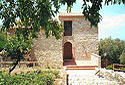 La Casa Vecchia |
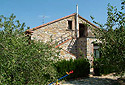 Nilo |
 Petrosa |
| Speakers | FAQ | Wanted | Policy Terms | Links | Scriblum Writers © 2019 The Parmenideum at Elea |